

The best AI model changes every quarter. Your business can't change platforms every quarter. Eighteen months ago you standardised on the sensible choice; today it isn't — and the cost of moving everyone again is why you haven't. Here's how to adopt whatever ships next without migrating anything.
The real question
Every platform switch carries the same bill: retraining, rebuilt prompts and integrations, another security review, another procurement round. So most businesses either stay loyal to a model that's no longer the best, or live in permanent migration. Neither keeps up. One 2025 survey of enterprise CIOs found 37% now run five or more models, partly to avoid betting on a single vendor; as one put it, "the model we standardised on is superseded every three months."

How to do it
Separate the platform your people learn from the models it runs. Staff get one workspace — prompts, skills, memory and controls — and underneath it, models become interchangeable parts. Connect providers however you buy them: direct API keys, cloud model services, managed subscriptions. When a better model arrives, add it beside the incumbents and compare on real work.
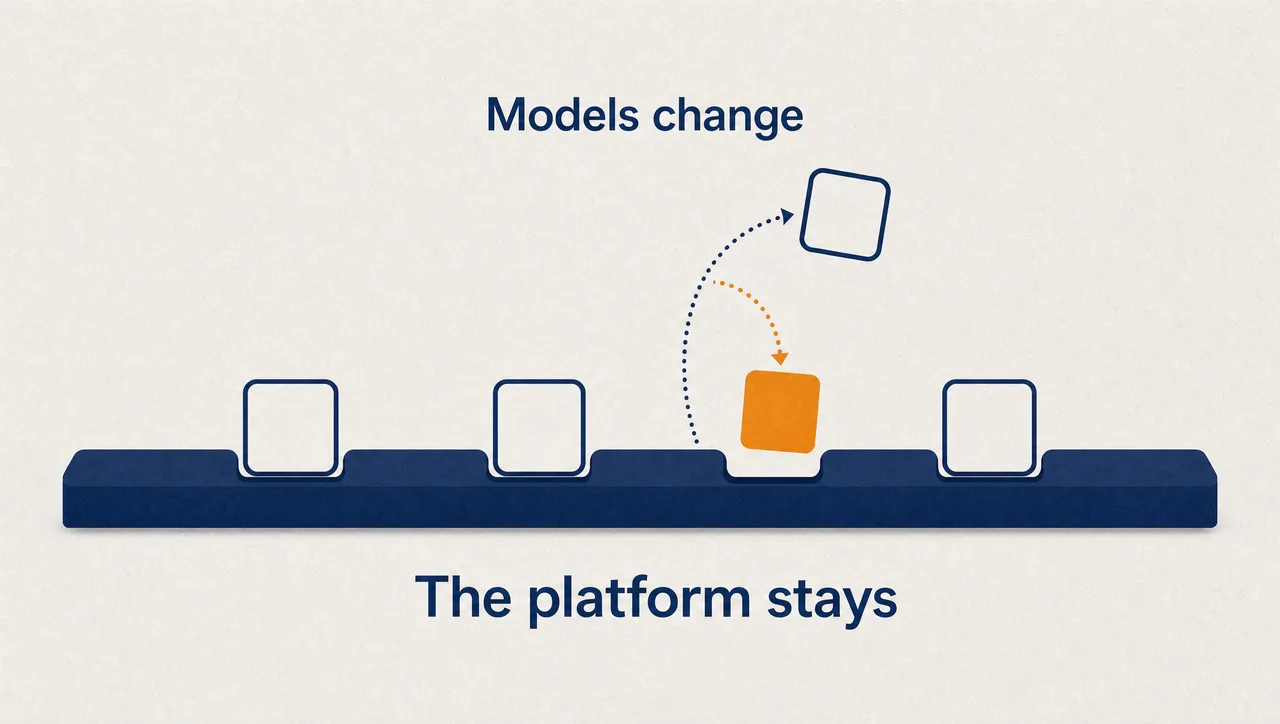
Don't rip out what works. If the business already pays for an AI subscription, connect it at organisation level and run its models inside the governed workspace — same models, same contract, your controls around them. And keep a lane for models you run yourself: an OpenAI-compatible endpoint on your own hardware can sit in the same model picker as the frontier options.
Then make enabling a model an administrative decision, not a project: which models are available, and to which teams, becomes a settings change — reversible, scoped, done before lunch.
What this looks like
In Pebble, this looks like: an administrator connects the providers the organisation already has — API keys, AWS Bedrock, the ChatGPT subscription the business already pays for, added once at organisation level. Models are enabled per organisation and workspace from one catalog. When a stronger model ships, the admin switches it on for the workspaces that need it; staff see a new option in the model picker, and switching mid-conversation keeps the thread. The data team points Pebble at Ollama running on their own hardware for work that stays in the building. Three "best models" later, nobody has been retrained onto anything.
Why this holds up in a regulated business
- Models run through API keys, AWS Bedrock, or centrally managed ChatGPT and Claude subscriptions; staff switch mid-conversation without losing the thread.
- Admins manage which models are enabled and provisioned per organisation and workspace; routing strategy is admin-set and applies service-wide.
- The ChatGPT subscription you already pay for connects at organisation level, governed by the same catalog controls as every other provider.
- OpenAI-compatible local model providers such as Ollama connect directly — no stored credentials required for providers that don't need them.
- Deployed across US, Europe and Australia.
One honest limit: subscription connections are organisation-level — personal ChatGPT accounts and history don't migrate — and with local providers you run the endpoint; Pebble connects to it, and doesn't host the model.
Where to start
Put your incumbent and one challenger side by side in the same workspace and let a fortnight of real work argue. When the next frontier model ships, adopting it is a settings change, not a steering committee. Make the platform the constant and the models interchangeable.
Pebble Powered AI.