

Copilot, ChatGPT, Claude, Gemini. Somewhere in your business someone is building the comparison spreadsheet; somewhere above you, someone wants to know which one you're picking. The trick answer: you don't have to pick — there doesn't have to be a winner.
The real question
The comparison can't be won. Every vendor publishes a page proving they beat the others — Microsoft maintains its own Copilot-versus-ChatGPT comparisons — and the leaderboard reshuffles every quarter. Pick a winner and you'll spend next year explaining why you bet the business on the one that just fell behind. Meanwhile the evaluation has quietly become procurement: marketing on one subscription, developers expensing another, the Microsoft agreement bundling a third — overlapping per-seat charges for tools doing broadly the same job. Nobody says it out loud: the bake-off isn't a decision. It's paralysis with an invoice.

How to do it
Stop shopping for a winner and consolidate instead. Set up one governed workspace where models from multiple providers sit in the same picker. People compare them on real work, not benchmark charts — same brief, two models, one conversation, no lost thread. When the market shifts, you change a setting, not a platform.
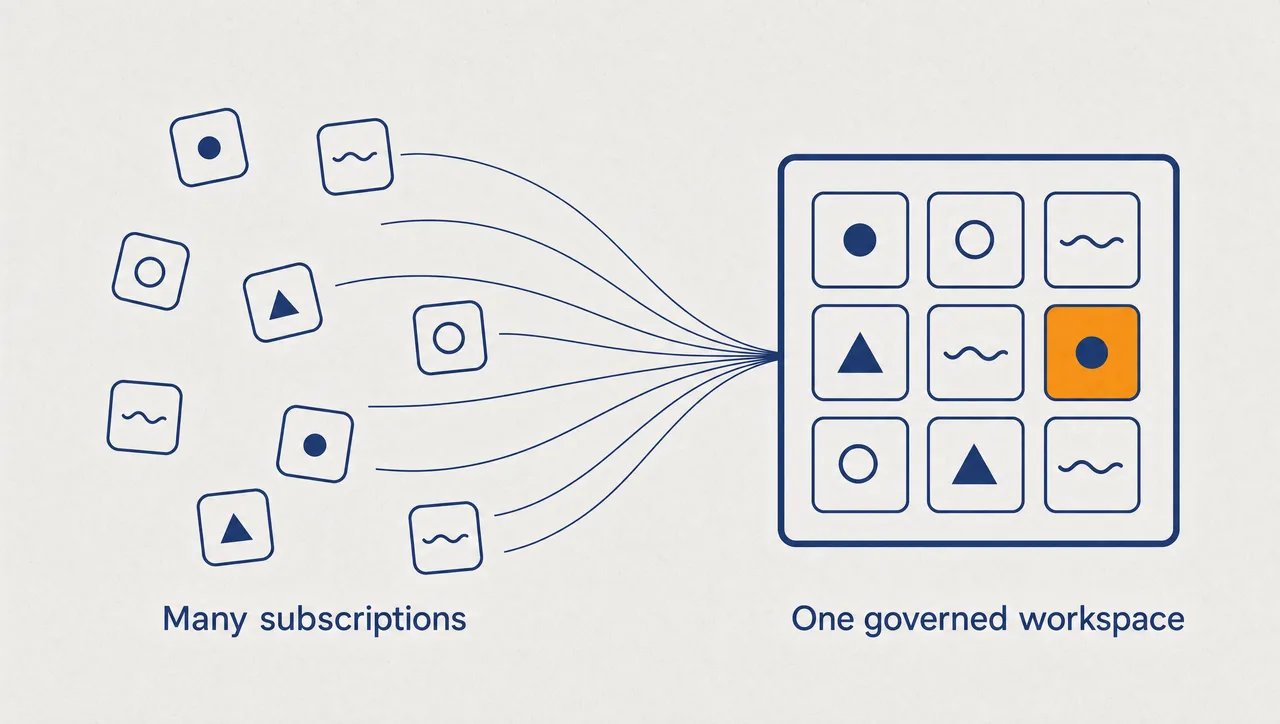
Then connect the subscription you already pay for. An organisation-level connection brings its models into the same workspace, with your governance around them. The people who love those models keep them — and you stop buying a second subscription just to run a comparison.
Finally, put the work where your business tools already are — mail, calendar, documents, spreadsheets — each person under their own sign-in, seeing only what they already have access to. "Which chatbot wins?" becomes "where does the work happen?" — which has a stable answer.
What this looks like
In Pebble, this looks like: an administrator connects the organisation's existing ChatGPT subscription at organisation level and enables its models in the same catalog as models running through API keys or AWS Bedrock. A digital lead drafting a supplier briefing switches models mid-conversation to compare answers on the same thread. The Microsoft 365 hub puts Outlook, SharePoint, Teams, Excel and OneDrive to work from chat, each person under their own sign-in. And the monthly vendor review is a settings page — which models are enabled, per organisation and workspace — adjusted in minutes.
Why this holds up in a regulated business
- Models from multiple providers run in one workspace — API keys, AWS Bedrock, or centrally managed ChatGPT and Claude subscriptions — and switching mid-conversation keeps the thread.
- Subscription connections are added at organisation level; their models are enabled through the same catalog controls as every other provider.
- Admins manage which models are enabled and provisioned per organisation and workspace; routing strategy is admin-set, service-wide.
- Microsoft 365 — Outlook, OneDrive, Excel, Teams, SharePoint — works from chat under each person's own sign-in; admins can switch individual tools off.
- Deployed across US, Europe and Australia.
Two honest limits: managed-subscription connections are evidenced for ChatGPT and Claude, not every vendor; and an organisation-level connection doesn't migrate anyone's personal ChatGPT account or history.
Where to start
Start with a connection, not a decision. Bring the subscription you already pay for into one governed workspace, enable a second provider's models beside it, and let a month of real work answer what the spreadsheet never could. You haven't picked a vendor; you've kept them all honest. Consolidate AI across your business.
Pebble Powered AI.