Some documents can never touch a third party. Legal matters. Casework. Client-privileged files. Cloud AI under negotiated terms answers most of your work — but this material carries a harder rule: it does not leave. The rule is right. It just doesn't have to mean no AI.
The real question
The default policy for privileged material has been abstinence — no AI at all — and plenty of organisations have settled there. But abstinence compounds: the teams with your most demanding documents get the least capable tools while everyone else speeds up. Residency guarantees don't resolve it, because residency is not sovereignty — data stored in your country is still data on someone else's infrastructure. Public-sector procurement has already moved from "where is the data stored?" to "who controls the infrastructure?" For the never-leave documents, only one answer passes: you do.
How to do it
Run the model yourself. Stand up an OpenAI-compatible endpoint inside your own network — Ollama is the usual choice — and point your AI workspace at it. Every prompt, and every document the model reads, stays on infrastructure you operate. There's no data-processing agreement to negotiate with your own server room.
Then the step most people miss: embeddings. Before AI can search your documents, every page runs through an embedding model — and that model is usually a vendor default you never chose. Make it an organisational decision: select the embedding model behind your knowledge sources deliberately, and record why.
Finally, treat the documents as governed knowledge sources, not ad-hoc uploads. Connect the libraries where the files already live — including servers inside your own walls — and refresh them on a schedule, so answers track the current version, not a copy someone exported in January.
What this looks like
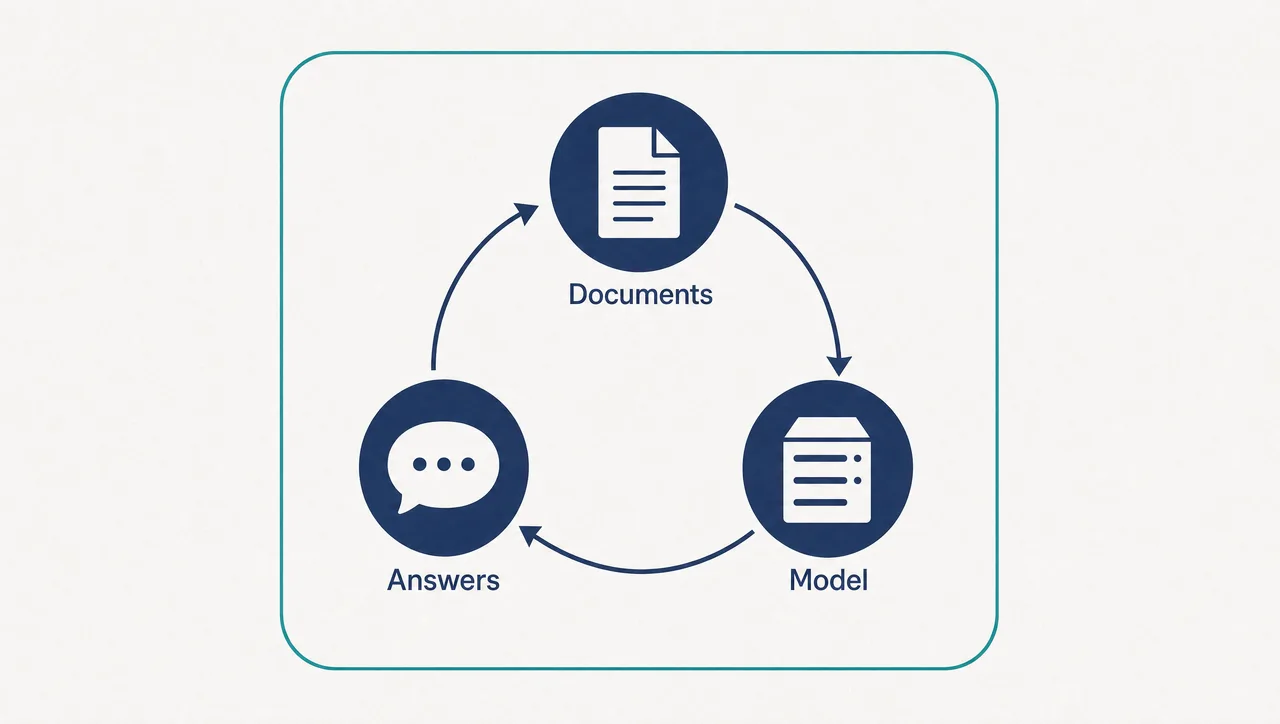
In Pebble, this looks like: the platform team stands up Ollama inside the corporate network and adds it as an OpenAI-compatible model provider, with no credentials stored. The administrator sets the organisation's default embedding model deliberately, not by inheriting a vendor's pick. The casework library — a SharePoint Server site — becomes a document store, signed into with Kerberos and refreshed on a schedule. A caseworker asks for precedents across a set of privileged matters. Retrieval runs against the governed store; generation runs on the box down the hall. The documents stayed where they have always lived, and the model that read them belongs to the organisation.
Why this holds up in a regulated business
- OpenAI-compatible local model providers such as Ollama connect directly, with no stored credentials for endpoints that don't need them.
- Your organisation selects the default embedding model behind its knowledge sources rather than inheriting a vendor default.
- Document stores support SharePoint Online and SharePoint Server, with NTLM, ADFS and Kerberos sign-in for enterprise environments.
- Stores refresh automatically on a schedule, with progress visible while they run.
- Deployed across US, Europe and Australia.
One honest limit: the platform connects to your local model endpoint — it doesn't ship or host the models. Running and sizing that endpoint is your infrastructure work — exactly what makes the lane yours.
Where to start
Pick one set of never-leave documents — a single casework library is ideal — and build the lane end to end: local endpoint, chosen embedding model, governed store. Same privileged files, real answers, and not one page crossed a third party. AI on your documents, inside your walls.
Pebble Powered AI.